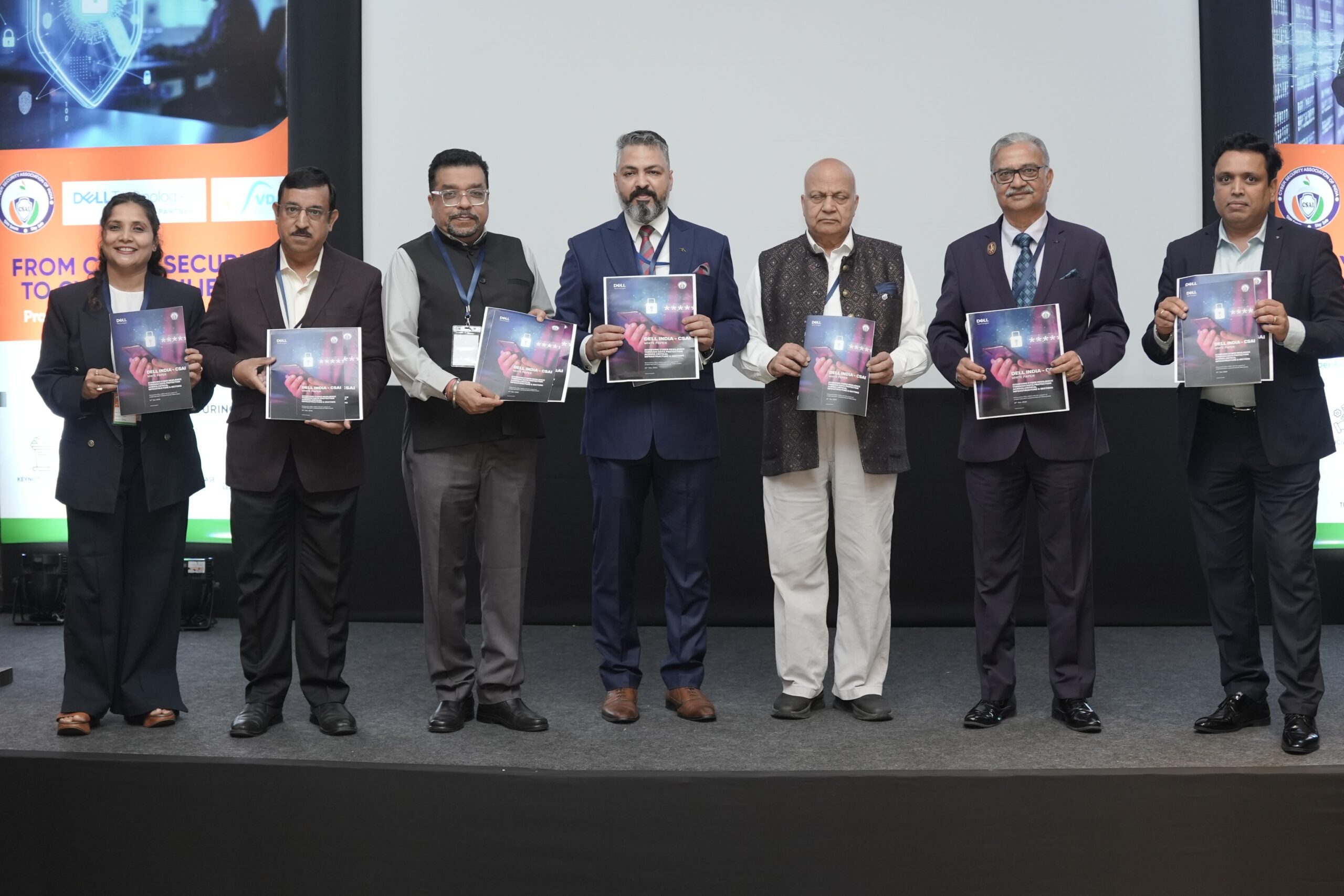
Dell Technologies and the Cyber Security Association of India (www.ncsai.in CSAI), through a newly released joint whitepaper, have highlighted a growing reality for Indian enterprises. As ransomware, data corruption and supply-chain attacks become more sophisticated and destructive, traditional backup and disaster recovery are no longer enough, making a shift to “clean cyber recovery”, where organisations can restore from isolated, trusted and provably uncorrupted data, a business imperative.
This joint paper examines how organisations can strengthen cyber resilience in line with the NIST Cybersecurity Framework (CSF), particularly its Respond and Recover functions, and why recovery must now be treated as a board-level, business continuity priority rather than an IT afterthought.
“Across industries, we are seeing a widening cyber maturity gap. While detection and prevention have advanced, recovery strategies have not kept pace with the realities of modern attacks,” said Venkat Sitaram, Senior Director and Country Leader, ISG Solutions, Dell Technologies India. “In many incidents, the biggest challenge is no longer stopping the breach, but finding a clean, trusted copy of data to restart the business. This is where clean cyber recovery, built on isolation, immutability and intelligence, becomes the true last line of defence.”
The whitepaper highlights three foundational shifts required for enterprises and operators of critical infrastructure:
- From connected backups to isolated cyber vaults: Air-gapped vaults with independent networks and credentials ensure clean recovery copies remain protected, even if production environments and identity systems are compromised.
- From basic retention to regulatory-grade immutability: Immutability enforced with dual controls, protected time settings and audit trails prevents even privileged users from altering or deleting critical data, a necessity for regulated and mission-critical environments.
- From anomaly alerts to content-level integrity analytics: Deep content analysis, beyond metadata, helps organisations identify the last known-good recovery point and restore with confidence, without reintroducing hidden corruption or malware.
According to Prof NK Goyal, President, CSAI, “Cyber resilience today is defined by how confidently an organisation can recover, not just how quickly it can detect. Clean cyber recovery aligns technology, governance and policy to a common objective: ensuring that when an incident occurs, the business can be restored from data that is trusted, immutable and forensically sound. This is critical for India’s digital economy and for sectors that underpin national services.”
By aligning architectural best practices with the NIST CSF and global security frameworks, Dell Technologies and CSAI aim to help enterprises move towards a more mature, recovery-first posture – one that combines zero-trust principles, isolated cyber vaults, strong governance, and deep data integrity validation.
As cyber threats escalate, resilience is moving from an IT metric to a business survival metric. The real test is no longer whether data is backed up, but whether organisations can restore operations from a clean, uncompromised foundation.