

Eighty percent of CEOs expect AI to force a high to medium degree of change to their operational capabilities, shifting the focus from digital business to autonomous business, according to a survey from Gartner, Inc., a business and technology insights company.
“Autonomous business is a strategy where self-learning software agents and machine customers make decisions, take action and create new types of value for organizations. CEOs see this shift as an immediate operational goal,” said Don Scheibenreif, Distinguished VP Analyst at Gartner. “While digital business changes what the organization does, autonomous business changes how the organization does it.”
The Gartner CEO and Senior Business Executive Survey of 469 CEOs and other senior business executives worldwide was conducted across three quarters, ending in the fourth quarter of 2025.
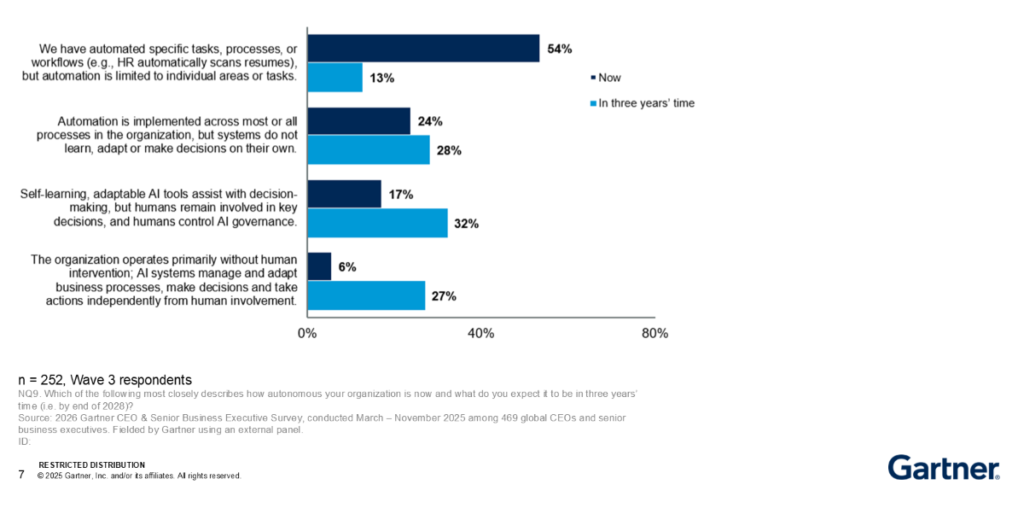
The survey found that 54% of CEOs said their automation was limited to specific tasks; by the end of 2028, only 13% expect to remain at this level. Conversely, 32% of CEOs expect their organizations to deploy self-learning and adaptable AI tools to assist with human decision-making, while 27% expect their organizations to operate primarily without human intervention, signalling a move to autonomous business ecosystems (see Figure 1).
Figure 1: CEO Anticipated Adoption of Automation and Autonomous Capabilities
Source: Gartner (April 2026)
“CEOs are realizing that AI is not simply another layer of automation. It is a catalyst for rebuilding the enterprise itself,” said David Furlonger, Distinguished VP Analyst at Gartner. “This transition to autonomous business requires CEOs to have a capabilities‑first mindset that prioritizes how work gets done and how value is delivered in an increasingly autonomous economy.”
While automation and autonomous business can provide efficiency gains, they can also become a competitive threat.
Transactional Revenue Is at Risk from AI
Some CEOs expect AI to have a negative impact on their profit models. Twenty-eight percent of CEOs surveyed said transactional revenue was most at risk from AI, as AI agents could bypass existing intermediated systems or their ability to conduct real-time pricing and negotiation.
“As AI agents automate purchasing, pricing, and negotiation, they remove the extra steps and inefficiencies that transaction fees were designed to cover. This is forcing CEOs to rethink profit models and pivot toward recurring, outcome‑based revenue models to avoid losing profit,” said Furlonger.
Customer Base Remains Unchanged
Only 17% of CEOs expect significant changes to their customer base due to AI, compared to 39% during the digital era. Instead, business leaders are primarily using AI to deepen relationships with existing customers and, increasingly, machine customers.
Gartner predicts that through 2026, the number of large companies that have a dedicated business unit or sales channel to access fast-growing machine customer markets will double versus 2024.
For CIOs, this underscores the need to build systems that support both human and machine decision‑makers, with trust, accuracy, and data integrity at the core.
“To prepare for this inevitable future, CEOs and CIOs must lead their organizations to rebuild their operational foundations and reengineer their people, assets, and financial structures,” said Scheibenreif.