The rapid adoption of artificial intelligence and emerging technologies is changing what employers expect from graduates, prompting universities to rethink how they prepare students for the workplace. LinkedIn’s Work Change Report: AI Is Coming to Work found that by 2030, 70% of the skills used in most jobs are expected to change, with AI as a primary catalyst, and that professionals entering the workforce today are on pace to hold twice as many jobs over their careers as workers did 15 years ago. As AI becomes increasingly integrated into industries, technical knowledge alone is no longer sufficient. Students are also expected to demonstrate digital fluency, problem solving, adaptability, creativity and the ability to apply technology to real world challenges. This is encouraging higher education institutions to bring AI, data, digital tools and applied learning closer to the centre of the student experience.
Among institutions responding to this shift is the University of Southampton, where the AI@Southampton initiative brings together disciplines from across the university to advance AI research, education and knowledge exchange. Coordinated by the Web Science Institute, it works with businesses, public services and local communities, and aims to grow the university’s AI related training, courses and degrees. Its focus on responsible, civic AI reflects the need to prepare students to apply technology to real world challenges.
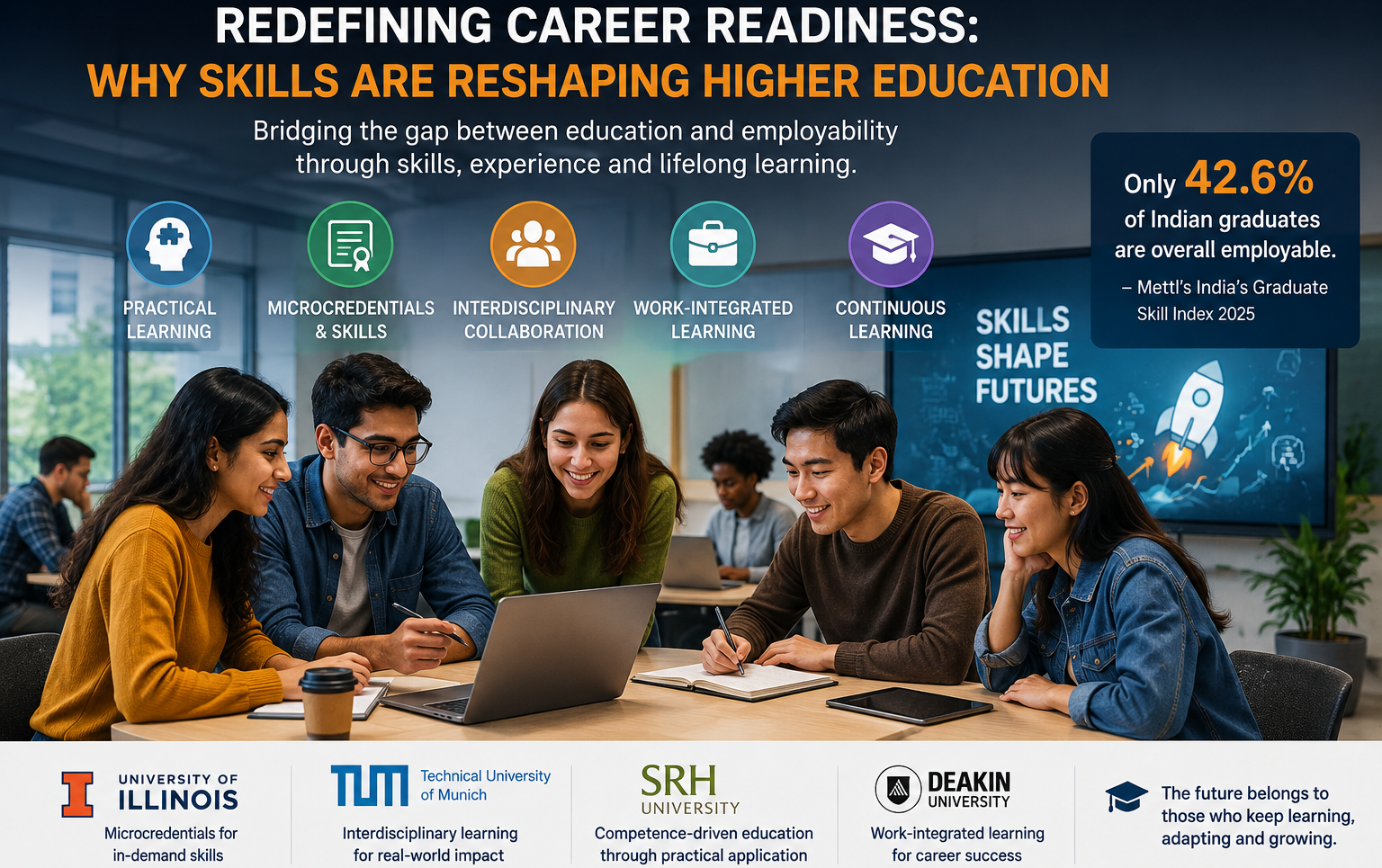
A similar focus on interdisciplinary and technology enabled learning can be seen at the Technical University of Munich, where students have opportunities to work across disciplines through project based formats. Its approach brings together areas such as entrepreneurship, innovation, creativity and technology, giving students opportunities to apply academic knowledge to complex challenges. Such experiences are increasingly relevant as AI and emerging technologies require professionals to work across traditional academic and industry boundaries.
SRH University in Germany has embedded competence development and practical application into its academic model through its CORE (Competence Oriented Research and Education) principle. Instead of relying primarily on conventional lecture based teaching, students work through focused learning blocks that combine academic concepts with projects, collaboration and practical application. Its academic portfolio also includes programmes across areas such as artificial intelligence, data science, information technology and AI in business, enabling students to build technology related knowledge alongside broader professional competencies. This combination reflects the growing need for graduates who can understand emerging technologies and apply them in practical and interdisciplinary settings.
Deakin University offers another perspective through its focus on employability, digital capability and work integrated learning. Its approach gives students opportunities to gain practical experience through industry projects, placements, simulations and other workplace based experiences. By connecting academic learning with professional environments, students can develop technical and transferable skills while gaining exposure to how technology is applied in real workplace contexts. Its emphasis on professional practice also reflects the growing importance of demonstrating capabilities alongside formal qualifications.
These approaches reflect a broader shift in how higher education defines employability in an AI driven economy. Graduates increasingly need to combine subject knowledge with technological literacy, critical thinking, collaboration and adaptability, while universities that connect academic depth with technology skills, practical experience and continuous learning can help students build the capabilities needed to navigate an evolving, technology driven world of work.