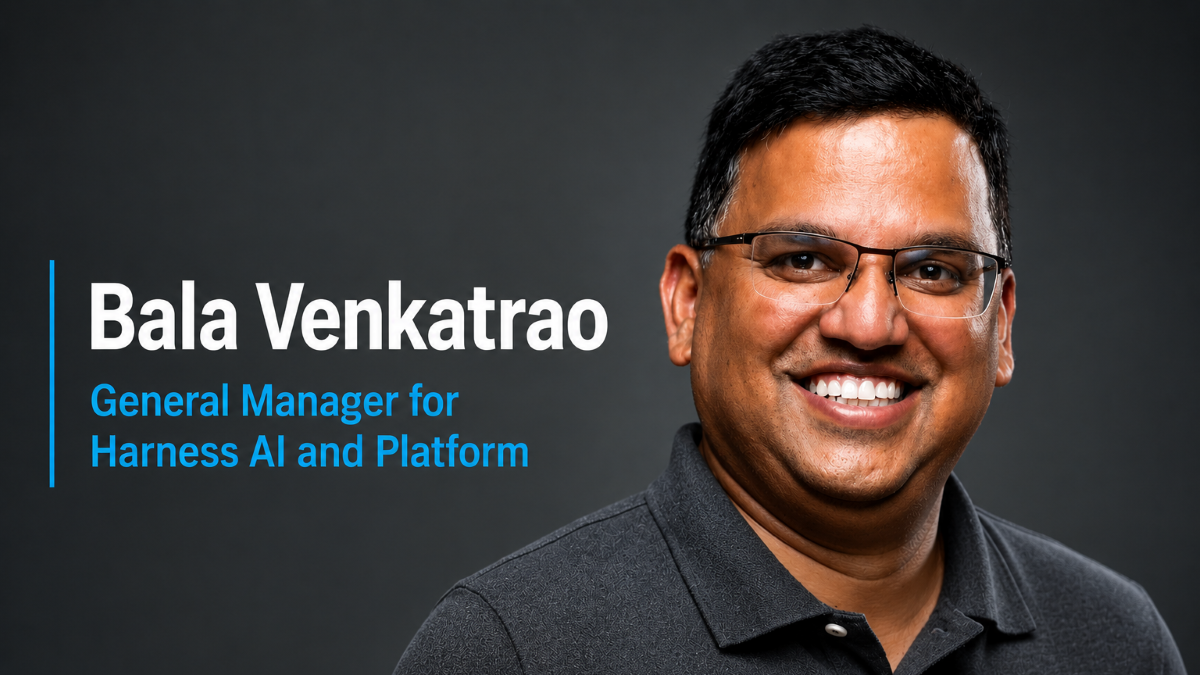
“Scale and autonomy introduced through modern automation systems are now pushing platform engineering into a different phase. When systems are capable of making operational decisions in real time, standardisation alone is no longer sufficient. Organisations need governance models that can actively enforce policies across security, compliance, reliability, and cost without depending on manual intervention,” says Bala Venkatrao, General Manager for Harness AI and Platform, who, in an interaction with Enterprise Times, talks about how platform engineering is evolving from enablement toward system-enforced governance.
Enterprise Times: What it means to treat AI agents as first-class actors within platform systems and how to govern them?
Bala Venkatrao: AI agents are moving beyond assistive tooling into systems capable of generating code, provisioning infrastructure, triggering workflows, remediating incidents, and making operational decisions independently. Treating them as first-class actors means recognising that they are no longer passive tools within the software lifecycle, but active participants interacting directly with platforms, pipelines, and production systems.
That fundamentally changes the governance model. Traditional platform governance was designed around human-driven workflows, where approvals, accountability, and access controls were attached to users and teams. Introducing autonomous agents into that environment requires platforms to govern machine-driven actions with the same rigor applied to human actions.
This is where platform engineering is evolving from enablement toward system-enforced governance. Every automated action, whether provisioning infrastructure, modifying deployments, or interacting with sensitive systems needs to operate within clearly defined security, compliance, operational, and cost guardrails. Governance can no longer depend on periodic reviews or manual oversight alone. It has to be embedded directly into the platform through policy-as-code, real-time enforcement, identity-aware controls, and continuous validation.
The challenge is now to ensure that autonomy can scale safely, predictably, and responsibly across increasingly complex software environments.
Enterprise Times: Why does cost need to become a real-time, enforceable decision?
Bala Venkatrao: The pace of modern software delivery means infrastructure, compute, and automation decisions are happening continuously across engineering environments. In that context, cost can no longer be treated as a retrospective reporting metric reviewed after resources have already been consumed. It increasingly needs to function as a real-time operational signal embedded directly into delivery systems.
Historically, cost optimisation sat largely within finance or operations functions. Today, decisions around infrastructure provisioning, compute usage, storage allocation, deployment strategies, and automation workflows are being made dynamically by engineering teams and increasingly by automated systems. That changes the role of cost from passive visibility to active governance.
Real impact comes when organisations can enforce policies dynamically through guardrails tied to budgets, infrastructure usage, workload prioritisation, and resource efficiency. Whether it’s preventing over-provisioned infrastructure, controlling excessive compute consumption, or managing automation-driven sprawl, real-time enforcement becomes critical to maintaining operational sustainability at scale.
The broader shift is that cost optimisation is becoming an engineering discipline rather than a reporting exercise.
Enterprise Times: How can teams minimise platform sprawl through consolidation and standards, especially as AI accelerates code and automation?
Bala Venkatrao:The ability to generate code, workflows, infrastructure configurations, and automation pipelines at much higher speed is increasing operational complexity across engineering organisations. Wh ile productivity gains are significant, the side effect is often platform sprawl, fragmented tooling, duplicated workflows, disconnected automation layers, and inconsistent operational practices across teams.
The challenge is not just the number of tools being introduced, but the lack of consistency in how systems are built, deployed, and governed. Without clear standards, complexity compounds quickly and becomes difficult to manage at scale.
This is something we’re increasingly seeing across software delivery environments at Harness, where organisations are prioritising greater workflow consistency and operational visibility as platform complexity grows. More teams are recognising that scaling engineering velocity is not simply about adding more tooling, but about creating greater coherence across workflows, governance models, and operational practices.
Standardisation becomes critical not only for operational efficiency, but also for maintaining reliability, security, and compliance across distributed systems. Policy-as-code, reusable workflows, and centralised governance models help organisations balance developer autonomy with operational consistency. Ultimately, long-term scalability depends less on how many tools organisations adopt and more on how effectively those systems operate together.
Enterprise Times: What this shift means for engineering teams operating at scale in India?
Bala Venkatrao: For engineering teams operating at scale in India, this shift represents a significant evolution in both responsibility and influence. India’s tech ecosystem is no longer focused primarily on execution or support functions. Teams here are increasingly building globally scaled platforms, driving product strategy, and operating systems that support distributed engineering organisations across markets.
At the same time, expectations from engineering teams are changing. The focus is moving beyond delivering features quickly toward building systems that are resilient, governed, cost-aware, and capable of operating reliably at scale. That requires much deeper integration between engineering, platform operations, security, compliance, and business priorities.
India is uniquely positioned in this transition because of the depth of engineering talent, experience operating large-scale distributed systems, and growing ownership of globally used platforms and products. The shift toward policy-driven governance also means teams need to think more holistically about system design, operational accountability, and long-term sustainability rather than isolated technical execution.
The broader opportunity is that engineering teams in India are increasingly becoming central to how global organisations design, govern, and scale modern software delivery platforms. That marks a meaningful shift from participation in global systems to ownership of them.
Enterprise Times: Why is platform engineering moving from standardisation to system-enforced governance?
Bala Venkatrao: Platform engineering initially evolved to solve problems around developer experience, operational consistency, and standardisation across increasingly complex software environments. Standardised workflows, reusable templates, and self-service infrastructure helped organisations scale software delivery more efficiently.
However, the scale and autonomy introduced through modern automation systems are now pushing platform engineering into a different phase. When systems are capable of making operational decisions in real time, standardisation alone is no longer sufficient. Organisations need governance models that can actively enforce policies across security, compliance, reliability, and cost without depending on manual intervention.
At Harness, we see this shift happening as organisations move away from governance models that rely heavily on disconnected approvals and reactive controls, toward platforms where guardrails are embedded directly into delivery workflows. The focus is increasingly on creating systems where governance operates continuously in the background rather than slowing down delivery through manual checkpoints.
The next phase of platform engineering will be defined by how effectively organisations can govern autonomy in real time while maintaining operational resilience at scale.
Enterprise Times: How policy-as-code enables continuous compliance and real-time decisioning across delivery?
Bala Venkatrao: Policy-as-code is becoming foundational to modern platform engineering because it allows governance to move from static documentation and manual approvals into automated, enforceable systems embedded directly within software delivery workflows.
Traditionally, compliance and governance processes operated as periodic checks layered on top of development and infrastructure workflows. The challenge with that model is that it cannot keep pace with the speed, scale, and complexity of modern software delivery environments, where changes are happening continuously across systems and teams.
A growing priority across software delivery environments we see at Harness is making governance a continuous function within engineering workflows rather than an isolated checkpoint after deployment. Policy-as-code enables this by converting organisational rules around security, compliance, infrastructure usage, reliability, and cost into machine-readable policies that can be evaluated continuously and enforced in real time.
Instead of identifying issues after deployment through audits or reviews, organisations can validate configurations, enforce operational guardrails, and trigger remediation automatically as systems are being built and deployed. This allows compliance, security, and operational accountability to become embedded directly into the delivery lifecycle rather than operating as separate downstream review stages.