
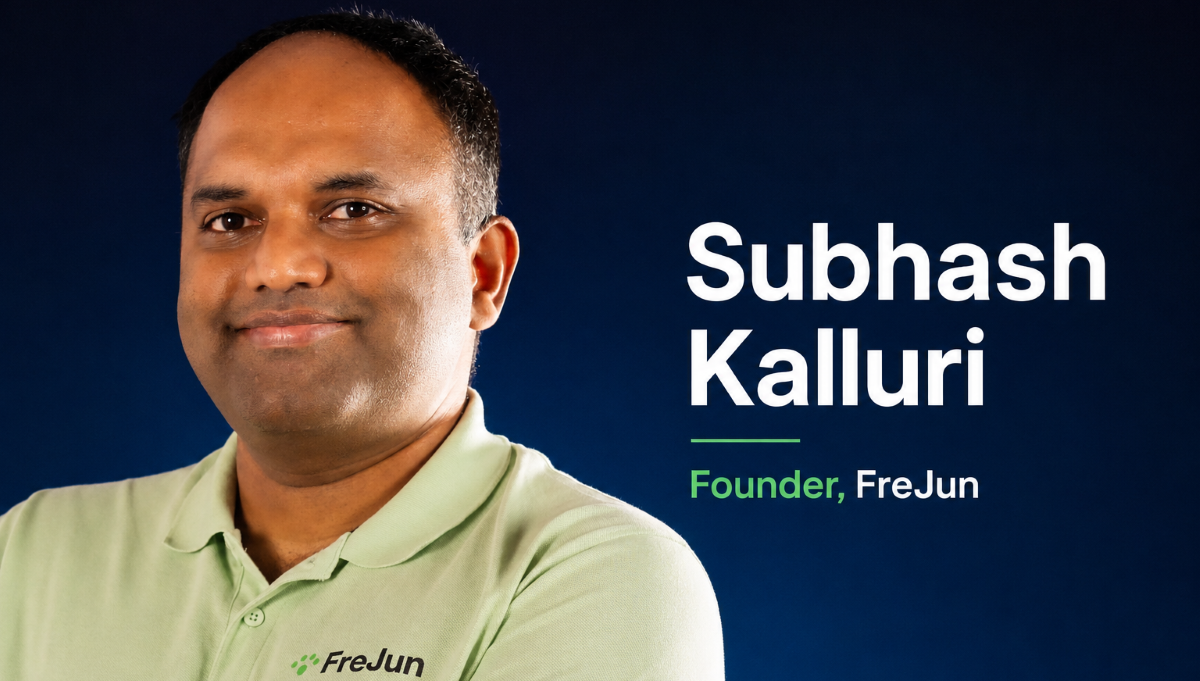
“Regulatory compliance is becoming a differentiator in enterprise voice AI,” says Subhash Kalluri, Founder, FreJun, in an interaction with Enterprisetimes.in. In this interview, he explores how advances in large language models are transforming enterprise telephony, and why low latency, regulatory compliance, and seamless CRM integration are becoming critical differentiators.
Enterprise Times: Voice is one of the oldest communication channels, yet enterprises still struggle to automate it. Why has it taken this long, and what’s finally changed?
Subhash Kalluri: Voice is more complicated than other channels. When you communicate over email or chat, it’s essentially asynchronous; the other party isn’t expecting an immediate reply, and it’s just words on a screen. Voice is different. It’s synchronous, and it carries far more than words: there’s emotion, and there’s a real back-and-forth conversation happening in real time. That makes it inherently harder to automate.
On top of that, voice introduces complications that text simply doesn’t have, for example, accents and slang. The same word I use in conversation might sound quite different to a machine than it would if it were typed out. That adds a layer of complexity.
That said, enterprises have already automated a great deal of voice communication, and we’ve come a long way. The reason it lagged behind email and chat is exactly this added difficulty. But with the recent advances in voice-based LLMs, we’ve made real progress. These models now understand the nuanced differences between accents and slang, and most importantly, they understand context. That contextual understanding is what allows them to hold a clear conversation.
The second challenge is the synchronous nature of voice itself. With email and chat, automation is easy because no one expects an instant response. With voice, unless the interaction is as smooth as talking to a human, you can’t fully automate it. Until LLMs can deliver that level of experience, complete automation isn’t possible.
The third layer is latency. To deliver a human-like experience today, what we’re typically doing is converting voice to text, processing that text through an LLM, and then converting the text back to voice. This entire pipeline inherently introduces latency, and latency is detrimental to a natural, human-like experience. Unless we solve the latency problem for voice agents which we’re actively working on and which is improving rapidly, we can’t fully automate voice as a primary communication channel.
Enterprise Times: India’s B2B calling volumes across sales, recruitment, and BFSI are massive. Does that scale give Indian voice AI companies a natural edge over Western players?
Subhash Kalluri: My answer is yes and no.
Where Western players are strong: in my understanding, they’re as good as us, probably slightly better at building the actual products.
But the clear, durable advantage for Indian voice AI companies is that we understand the customer better than anyone. Being a local player means the solutions we offer are far more customised to local needs. For example, rolling out a voice agent in Odia may not be a priority for a Western company, but it’s a key priority for a local player, and we’re motivated to cover as many geographies and languages as possible.
The other key difference: for Western players, India isn’t the primary market; that’s usually North America and Western Europe. For Indian voice AI companies, India will always be the primary market. That gives us a structural advantage in moving faster and offering a better solution here. That said, the real question is whether Indian voice AI companies can seize the opportunity, and it’s an immense one, and grab the market as quickly as possible.
Enterprise Times: What are the most common points where enterprise AI deployments fail at the telephony layer, and how does FreJun solve for them?
Subhash Kalluri: In my experience, enterprise voice AI projects rarely fail because the AI model itself is weak; they fail because the underlying telephony layer cannot meet the strict, real-time demands of the public telephone network. There are three main bottlenecks where these deployments break down, and platforms like FreJun solve for them directly.
● The Latency and ‘Awkward Silence’ Problem
○ The Challenge: In text chatbots, a 3-second delay is fine. On a phone call, anything over 1 second causes humans to talk over the bot, breaking the AI’s conversational state. Traditional telecom routing isn’t designed for sub-second, bidirectional streaming.
○ The FreJun Solution: FreJun solves this through its developer-focused voice infrastructure platform, FreJun Teler. It uses WebSockets to stream raw audio between live calls and the application backend, achieving sub-250ms latency. They combine this with geographically distributed media nodes to minimise data transit times.
● Carrier Interoperability and Complex SIP Infrastructure
○ The Challenge: AI engineers are experts in modern web APIs, not legacy telecom protocols like SIP trunking, PSTN signaling, and global compliance regulations. Forcing an AI team to build global telecom plumbing stalls deployments for months.
○ The FreJun Solution: FreJun acts as a specialised transport layer. It abstracts all the carrier complexity, number provisioning, and telecom compliance into clean, plug-and-play APIs and SDKs. This allows the engineering team to focus strictly on the AI logic while FreJun handles the network connectivity.
● Call State Control and ‘Closing the Loop’ with Enterprise Data
○ The Challenge: A real-world voice bot needs to do more than talk. It needs to handle live call operations, like putting a customer on hold, transferring to a human agent, and immediately updating data silos when the call ends.
○ The FreJun Solution: FreJun decouples the conversation from the network operations. While your AI handles the dialogue, FreJun’s Conversations API manages live call states like programmatic transfers. Furthermore, it features out-of-the-box CRM integrations with platforms like Salesforce and HubSpot, ensuring that AI-generated summaries and structured data are immediately pushed to business records post-call.
Enterprise Times: FreJun is fully bootstrapped in a category dominated by venture-backed competitors. How does that shape your product and growth decisions differently?
Subhash Kalluri: This is a very interesting question. As a bootstrapped company, one thing we’re very clear about is that we have no room for errors or mistakes. So where we really excel is in slowing down and taking the time to work on the right thing, rather than working on the wrong thing and wasting resources.
The whole point of raising capital is to buy time and bigger resources so you can try out more things and take bigger bets. We don’t have that luxury. So whatever we do has to make sense and has to stick to our ICP. That makes us very disciplined about a couple of things.
First, we’re very clear about who our ICP is, and all our efforts – product, marketing, and sales – are focused only on that ICP. Instead of doing a hundred things, we do only a few. As you can see, we have just two product lines, and both are built on voice. We’re very clear about who we are.
Second, we focus completely on the customer and don’t worry about short-term gains. We understand this is a long-term game. Whatever decisions we take might not yield results in the short term, so we have to be patient and convince ourselves that the bets we’re placing will work out over the long run.
Our decision to make the UAE a primary market is a good example. When we took that decision, it didn’t seem to make sense and looked very risky. But we made the hard call to start working on it, and we’re now beginning to see results in that direction.
At the end of the day, we believe there’s enough room for all the operators; everyone has their own strengths and weaknesses.
Enterprise Times: You hold a DoT VNO licence and operate across India, the UAE, and the US. How much of a differentiator is regulatory compliance becoming in enterprise voice AI?
Subhash Kalluri: Regulatory compliance is becoming a differentiator in enterprise voice AI, but I’d separate that into two layers, the geography-specific layer and the AI-specific layer, because they’re moving at different speeds.
On geography: the instrument changes by market, but the buying criterion doesn’t. In India, the DoT VNO licence is the relevant signal. It says we operate cleanly within Indian telecom regulations, and that gives enterprise buyers real confidence to work with us. I’d be honest about its limits, though; it’s a licence like any other, with around 200 holders in the region, so it’s not exclusive. But it’s not off-the-shelf either. You have to meet specific eligibility criteria, f ile quarterly AGR returns, and stay continuously compliant to keep it. So over the long term it makes a difference, because it reflects sustained discipline rather than a one-time checkbox, but it’s table stakes for credibility in India, not a moat.
In the UAE and the US, the VNO licence isn’t the relevant instrument; the global trust standards are. Our SOC 2, ISO 27001, HIPAA, and GDPR posture is what enterprise buyers actually procure against in those markets. So the through-line is that compliance matters everywhere; only the specific certification that proves it changes by region.
The more interesting shift is the AI-specific layer, and this is where compliance is genuinely becoming a differentiator rather than just being one. Voice AI raises questions plain telephony never had to answer: consent for automated and AI-driven calls, disclosure that the caller is an AI, call-recording consent across jurisdictions, voice data residency, and the early wave of voice-cloning and deepfake regulation. As AI agents start placing and taking calls at scale, vendors who’ve built for that layer will pull away from those who treated compliance as paperwork.
And ultimately this matters because our compliance flows into our customers’ compliance. For a bank or a healthcare provider, working with a vendor who is audited and certified de-risks their own regulatory exposure – it’s not just our confidence, it’s theirs. That’s the real reason it’s climbing up the enterprise buying criteria.
Enterprise Times: Where does the CRM-to-voice workflow most often break down for enterprise teams, and what does a genuinely integrated setup look like?
Subhash Kalluri: Honestly, the workflow rarely breaks because the tools are bad. Most teams have a solid CRM and a solid calling setup. The problem is the space between them; that’s where everything leaks.
The most common one is just logging. Representatives are calling from their phones, from a separate dialler, and sometimes over WhatsApp, and half those calls never make it into the CRM, or they get typed in two days later from memory. So you’ve got this system that’s supposed to be your source of truth, and it’s quietly missing a big chunk of what actually happened. Then someone’s looking at the pipeline making decisions on numbers that aren’t even complete.
The second thing is context, or the lack of it, right when the call happens. A representative dials someone and doesn’t have the deal stage or the last conversation in front of them, or they’re flipping between three tabs trying to piece it together while the phone’s ringing, and inbound is worse because a lot of the time the system can’t even tell them who’s calling before they pick up. You’re basically walking into the conversation blind.
And then there’s everything after the call. The recording’s stuck in the telephony platform, the transcript is somewhere else, and the representative has to manually log what happened and remember to create the follow-up. Every one of those little manual steps is a place where details get lost or follow-ups fall through the cracks.
So when people ask what “integrated” actually looks like, I’d say it’s when all of that just happens on its own. You click to call from inside the CRM, so you never leave the record. Every call logs itself against the right contact, whether it’s on a desk or a mobile. The recording and transcript attach automatically. The follow-up task gets created without anyone thinking about it. And the call data ends up structured enough that you can actually do something with it, like reporting, coaching, or feeding it into AI workflows, instead of it just being a pile of audio nobody listens to.
The test I always come back to is pretty simple: can a representative get through a whole call, the preparation, the conversation, the logging, the follow-up, without ever leaving the CRM or copy-pasting anything? If yes, it’s integrated. If they’re still manually bridging the gaps, then it’s not really integration; it’s just two tools sitting next to each other, hoping for the best. And that’s exactly the gap we built FreJun to close; it’s CRM-native from the start, not a dialler with integrations bolted on later.
Enterprise Times: Your customer base spans recruitment, edtech, BFSI, and healthcare. Which vertical is pushing your product the hardest, and what are they demanding that didn’t exist two years ago?
Subhash Kalluri: The verticals pushing us hardest are the ones with the least compliance drag, recruitment and edtech. They feel the efficiency and cost pressure as acutely as anyone, but they don’t carry the regulatory burden that slows other sectors down, so they can move fast and adapt aggressively.
BFSI and healthcare are a different story. The appetite is there, but they are far more compliance-heavy, so implementation is deliberately slower, and before they roll anything out, they need to be certain data is protected and every regulatory requirement is met. Healthcare lags the most because the cost of an error is high and the tolerance for mistakes is low. For accuracy-critical conversations, those teams still want a human in the loop and want to double-check everything before they trust an automated system.
But the more interesting shift is in what they’re asking for, because the demand simply didn’t exist two years ago, and the technology didn’t either. Two years ago, “voice automation” meant IVR trees and scripted bots: press-1 menus, rigid call flows, and a system that could read a script but couldn’t hold a conversation. Customers asked whether it could route a call or play a reminder.
Now the expectation is a genuine conversation. They want an AI voice agent that responds in real time, handles interruptions, understands context, and pulls live customer data mid-call instead of reading from a fixed tree. Sub-second latency, natural turn-taking, and the ability to actually reason through a conversation, none of that was on the table two years ago, and today it’s the baseline ask.
Enterprise Times: Five years from now, what does enterprise voice infrastructure look like, and where does FreJun position itself in this evolving landscape?
Subhash Kalluri: The biggest shift we see is in who is doing the talking. Today, voice infrastructure is built around humans calling humans. Five years from now, we expect most of the traffic to come from agents and, increasingly, agents communicating with other agents over voice infrastructure. When the callers aren’t human, almost everything changes underneath: latency tolerances tighten, authentication and protocols have to be rethought, and even billing models shift. These are some of the interesting problems we’re looking forward to solving.
A lot of this will be gated by the computational capacity of the servers we run on. We haven’t seen a major shift there yet, but we’re certain about the direction; we’re going to be handling far more voice traffic than we ever have, and we’re positioning for that rather than waiting for it to arrive.
The way I think about where FreJun sits is to compare us to a power generation company. From the outside it looks like a boring business, but there’s an enormous amount happening below the surface. That’s exactly where we want to be, the utility layer that everything else runs on. Not the flashy application on top, but the reliable, invisible infrastructure underneath it.
So our expectation is simple: we’ll still be in this space, serving many more customers, and serving them better, as the whole industry keeps pushing for higher voice quality, lower latency, and new ways to make voice infrastructure carry the next generation of agents.


