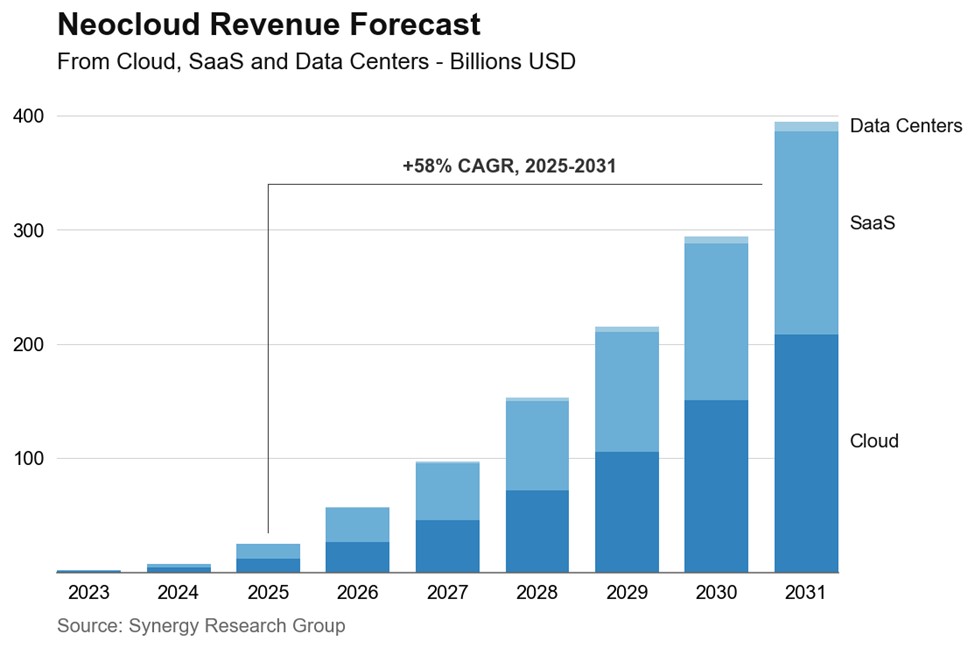
Data from Synergy Research Group has revealed that neocloud revenues are scaling at an unprecedented pace, reaching $9 billion in Q4—up 223% year-over-year—and exceeding $25 billion for full-year 2025. Driven by surging demand for AI infrastructure, Synergy forecasts the market will approach $400 billion by 2031, representing a sustained 58% compound annual growth rate.
This rapid expansion is being fueled by structural constraints in traditional cloud supply, as demand for GPU-accelerated compute continues to outstrip hyperscale capacity. As a result, neocloud providers are capturing an increasing share of the fastest-growing segments of the cloud market, fundamentally reshaping the competitive dynamics of AI infrastructure.
Neoclouds are emerging as a distinct and rapidly scaling category of cloud infrastructure, purpose-built to deliver high-performance, GPU-centric computing for artificial intelligence workloads. Focused on services such as GPU-as-a-Service (GPUaaS), generative AI platforms and high-density data center capacity, these providers are led by companies including CoreWeave, Crusoe, Core Scientific, Lambda, Nebius and Nscale.
Within this emerging competitive landscape, CoreWeave stands out as the most direct challenger to traditional hyperscale cloud providers. Meanwhile, OpenAI and Anthropic represent a distinct but increasingly important category—platform-centric providers offering cloud-like access to foundational models and AI development environments. Together, these players are reshaping the competitive boundary between infrastructure and platform layers in the cloud ecosystem.
While a long tail of newer entrants and transitioning crypto infrastructure providers continues to emerge, neoclouds are differentiated by their singular focus on GPU-accelerated compute—enabling greater performance density, faster deployment cycles and more efficient scaling for AI workloads. As demand for AI infrastructure accelerates, neoclouds are positioning themselves as focused alternatives to traditional hyperscale providers such as Amazon, Microsoft and Google.
“What we are observing is not merely the emergence of a new class of cloud provider, but a deeper structural realignment in the architecture of computation itself,” said Jeremy Duke, Founder and Chief Analyst at Synergy Research Group. “Traditional hyperscale systems were conceived around a form of generalized elasticity, whereas AI workloads impose far more rigid constraints—particularly around parallelism, locality and the concentration of compute. Neoclouds are, in effect, an architectural response to those constraints. As AI moves from exploratory phases into sustained, large-scale deployment, these underlying differences cease to be incidental and instead become determinative of how compute systems evolve.”