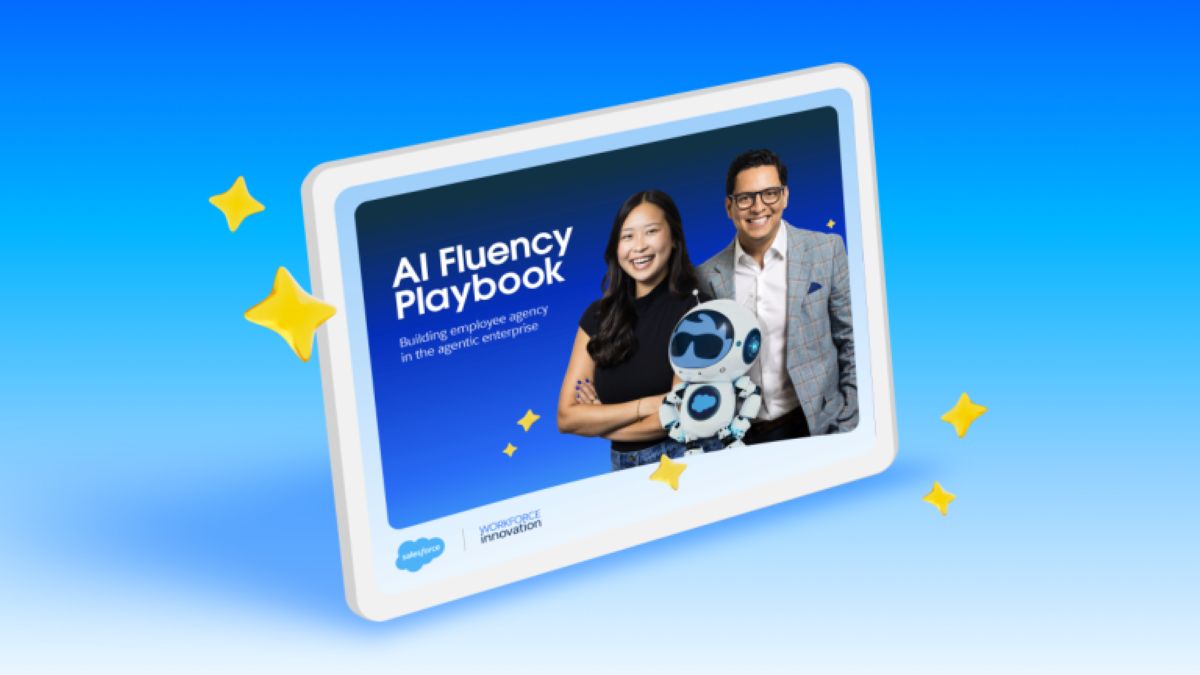
Salesforce has shared a practical guide to help businesses prepare their workforce to confidently collaborate with AI to give employees agents and drive business impact at speed and scale.
The AI Fluency Playbook offers insights into how organizations can effectively integrate AI agents into daily work processes, with the goal of increasing productivity and job satisfaction.
Research shows employees who use AI daily report 64% higher productivity, 58% better focus, and 81% greater job satisfaction. Businesses that build AI fluent workforces drive greater growth and position themselves to attract top talent and become a best place to work.
The AI Fluency Playbook is built from Salesforce’s own experience deploying AI agents as Customer Zero for Agentforce. Today, Salesforce employees are collaborating with agents, and 85% say they feel confident using AI tools to drive productivity in their daily work — a 16% increase year over year. In just one year, Agentforce in Slack saved employees over 500,000 hours, Engagement Agent worked over 190,000 leads with the sales team, and Service Agent handled over 2 million support requests for the customer service team.
Agents are unlocking possibilities for every worker by automating mundane tasks and augmenting employee potential. But to truly enhance daily work and drive better business outcomes, employees need the knowledge, skills, and tools to collaborate successfully with AI agents. Organizations can build this AI fluency in three ways:
- AI Engagement: Enhance employee sentiment and confidence around AI.
- AI Activation: Drive consistent adoption in employees’ daily work.
- AI Expertise: Build proficiency of human, agentic, and business skills that drive successful human + agent adoption.
“When we get AI fluency right, AI moves from a technology innovation into a workforce advantage — it’s the difference between deploying tools and actually changing how work gets done,” said Nathalie Scardino, President and Chief People Officer at Salesforce. “When AI is used proficiently, it not only delivers better business outcomes, it increases employee agency, giving people more control over how they work, decide, and create value.”