
Organizations that report successful AI initiatives invest up to four times more (as a percentage of revenue) in foundational areas, such as data quality, governance, AI-ready people and change management, compared to those that experience poor outcomes from AI, according to Gartner, Inc., a business and technology insights company.
However, a global survey of 353 data and analytics (D&A) and AI leaders from November through December 2025 also found that only 39% of technology leaders are confident that their enterprise’s current AI investments will have a positive impact on financial performance.
“D&A leaders play a central role in achieving their organization’s AI value ambition,” said Rita Sallam, Distinguished VP Analyst, Gartner Fellow and Chief of Research at Gartner. “Through 2030, the D&A leader’s mandate is to deliver foundational areas, including new trusted data, context foundations and perceptive intelligence. Responding to this mandate will require shifts in how the D&A team organizes and works, builds and scales and creates value (see Figure 1).”
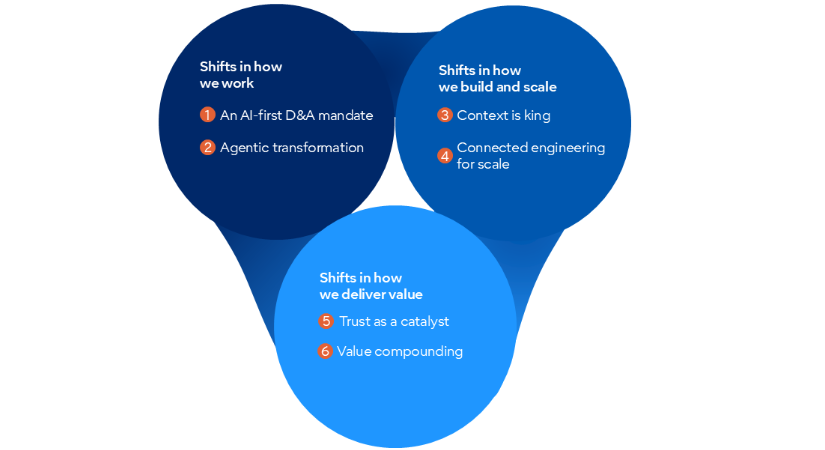
Source: Gartner (April 2026)
Shift 1: Build toward AI-first D&A
This shift starts and ends with an AI ambition for leveraging AI to transform, not tweak, business and operating models aligned to achieve audacious business objectives. Pioneering leadership is required to apply new technology in high value, innovative ways.
Shift 2: Redesign the D&A organization for human-agent collaboration
“The future is not about replacing humans, but amplifying their ingenuity,” said Sallam. “Because AI will create extra capacity, D&A teams will shrink in size and expand in impact. AI-first D&A organizations will have smaller, “tiny” teams organized as decision pods of broad-skilled talent augmented by AI and AI agents specialists focused on business outcomes. We see pacesetting companies experimenting with teams as small as one “technical” person and one “business” person.”
Shift 3: Establish Context as Critical Infrastructure
Gartner found that organizations with the highest maturity of AI-ready D&A capabilities are achieving up to 65% greater business outcomes, including revenue growth and cost optimization. D&A success in 2030 is not about better models — it is about giving agents governed, contextual access to the right data.
Agents cannot function autonomously without high-quality context and absolute trust. Context capabilities act as the brain for AI. Therefore, context, including semantics and metadata, are now mission-critical for D&A. D&A leaders must redesign the D&A architecture to make the context layer the central brain for AI agents to deliver trusted intelligence.
Shift 4: D&A organizations should scale connected engineering practices
Realizing AI ambition at scale requires new, deeply integrated engineering practices. Siloed practices for data, AI, context and software engineering will fail to realize an AI-first ambition.
D&A organizations should shift from an endless loop of proof-of-concept cycles to enterprise scale by building interconnected data, AI, software and context engineering practices and skills.
Shift 5: Establish trust as a catalyst of value and innovation
Governance is becoming the foundation for realizing value and driving innovation. However, a Gartner survey of 360 IT leaders in the second quarter of 2025 found that only 23% said they are very confident in their organizations’ ability to manage security and governance when deploying GenAI tools.
“Traditional control should be overhauled to prioritize trust-based governance models for AI agents by building dynamic governance to embed automated context and checks for bias, privacy, and compliance directly into workflows,” said Sallam. “Without trust in the data, outputs and decisions of AI models and agents, there is no value from AI.”
Shift 6: Move beyond ROI to value compounding
AI-first D&A leaders need to move beyond ROI to creating a value flywheel, where efficiency gains from high-impact investments are intentionally reinvested into growth and innovation.